
Short answer: The fatigue in perimenopause is different — it sits underneath everything, untouched by sleep, iron, or extra coffee. The biological reason: falling estrogen disrupts your cells' ability to clear out worn-out mitochondria, so damaged ones pile up and produce less clean energy. That cleanup process is called mitophagy. Urolithin A is the compound shown in human trials to switch it back on — at the machinery level, not like a stimulant — and it builds over 8–12 weeks, not overnight.
If you've never heard of urolithin A and you're wondering whether it's the next wellness fad or something real, the rest of this page walks through exactly what it is, why your tiredness has a biological cause that isn't your fault, and what the actual studies do — and don't — show.
What is urolithin A?
Urolithin A is a postbiotic — a compound your gut bacteria make when they break down ellagitannins, the plant molecules found in pomegranates, walnuts, raspberries, and strawberries. You don't eat urolithin A directly; your microbiome produces it from those foods (Journal of Agricultural and Food Chemistry, 2023).
Here's the catch: not everyone's gut makes a meaningful amount of it. Whether you produce urolithin A depends on having the right bacterial species, and a large share of people fall into a "low-" or "non-producer" category even when they eat the right foods — the research describes distinct urolithin metabotypes, with a meaningful slice of the population unable to convert ellagic acid into urolithin A at all (Journal of Agricultural and Food Chemistry, 2023). That's why it's taken as a supplement: a direct dose skips the gut lottery.
So no — it's not a trendy label slapped on a multivitamin. It's a specific molecule with a specific job.
How does urolithin A work for energy?
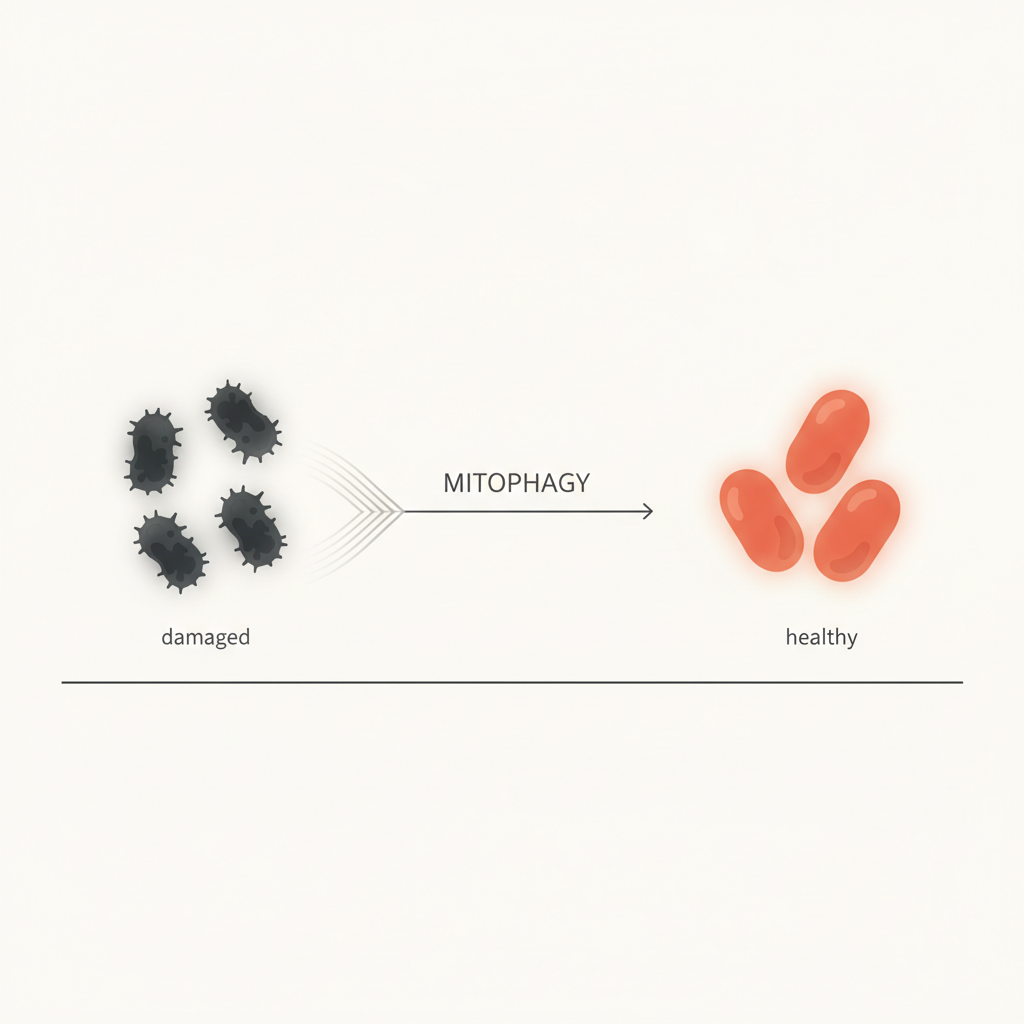
It works through a process called mitophagy — your cells' built-in recycling of damaged mitochondria.
Think of your mitochondria as the power plants in every cell. Over time, some break down and run dirty: they make less energy and more waste. Mitophagy is the cleanup crew that removes the broken ones so healthier mitochondria can take over. When that cleanup slows down, damaged mitochondria accumulate, and your cells produce less clean energy. You feel that as the kind of tired that coffee can't fix.
Urolithin A is the compound shown to reactivate mitophagy in humans. In a randomized, placebo-controlled trial published in JAMA Network Open (2022), 1000 mg of urolithin A per day for four months significantly improved muscle endurance in adults aged 65–90 compared with placebo, alongside biomarkers pointing to better mitochondrial efficiency (JAMA Network Open, 2022). A separate randomized trial in middle-aged adults, published in Cell Reports Medicine (2022), found the same compound improved markers of mitochondrial health (Cell Reports Medicine, 2022).
This is the part most products won't tell you straight: in that JAMA trial, peak ATP production wasn't significantly higher than placebo at four months (JAMA Network Open, 2022). The strongest, cleanest evidence is for the mechanism — switching mitophagy back on — and for measurable changes in endurance and inflammation, not for a guaranteed jump in "energy" you can put a number on. We'd rather tell you that than oversell.
Why does perimenopause make this worse?
Because estrogen is one of the things that keeps your mitochondrial cleanup running — and in perimenopause, estrogen falls.
This isn't a metaphor. A 2025 review in the International Journal of Molecular Medicine describes how "declining E2 [estradiol] levels during perimenopause disrupt key mitochondrial processes, such as biogenesis, antioxidant defense, calcium homeostasis, mitophagy and energy metabolism" (Int. J. Molecular Medicine, 2025). When estrogen drops, the mitophagy that clears out damaged mitochondria is compromised — so the broken ones build up faster, exactly when you have the least reserve to spare.
That's the link nobody connects for you out loud: estrogen decline → impaired mitophagy → damaged mitochondria accumulate → less clean cellular energy → the bone-deep tiredness you can't sleep off. It's biology, not a character flaw. You are not lazy, and you didn't let yourself go.
Urolithin A is interesting in this exact context precisely because it targets the same cleanup step — mitophagy — that estrogen decline disrupts.
Your Daily Renewal — 99.9% pure urolithin A at 1,000 mg per serving. The dose used in the JAMA trial cited above.
See the formula →Is it just marketing, or is there real science?
Real science — with honest limits, which is the difference that matters.
What the human trials actually show:
- Mitophagy activation and improved markers of mitochondrial health (Cell Reports Medicine, 2022).
- Significantly improved muscle endurance at 1000 mg/day over four months (JAMA Network Open, 2022).
- Lower inflammation — a significant drop in plasma C-reactive protein versus placebo (JAMA Network Open, 2022).
What the trials do not show — and what an honest source admits:
- A guaranteed, measured increase in everyday "energy." Peak ATP production was not significantly different from placebo in that trial.
- An instant effect. The studies ran for four months, not four days.
So if a product promises you a clean energy spike by next week, that's the marketing talking. The science supports a slower, structural change — fixing the machinery rather than borrowing a buzz. That's less exciting on a label and more honest in your body.
So — does urolithin A help with perimenopause fatigue?
Here's the honest verdict. Urolithin A targets the cellular mechanism — impaired mitophagy — that estrogen decline disrupts during perimenopause, and human trials back the mechanism, endurance, and inflammation findings at a 1000 mg dose. It is not a stimulant and not a same-week fix. If your exhaustion is the kind that vitamins, magnesium, B12, and iron never touched, that's a clue: those refill nutrient gaps, but they don't repair the energy machinery itself. Urolithin A works on a different layer.
It won't promise you a number. It will give your cells the one thing your gut may no longer make enough of on its own — and the patience to let it build.
If you want to try it the way the science was actually run: Suria's Your Daily Renewal is 99.9% pure urolithin A at 1,000 mg per serving — the dose used in the JAMA and Cell Reports Medicine trials cited in this article. One capsule a day. Give it the full 8–12 weeks the mechanism needs. This isn't another stimulant to mask the tiredness — it's the repair, done honestly. This isn't another stimulant to mask the tiredness — it's the repair, done honestly.
Suria is a dietary supplement. It is not intended to diagnose, treat, cure, or prevent any disease. Perimenopause is a natural life stage, not an illness — always talk to your own doctor about your health.
Editorial review: This article cites peer-reviewed randomized controlled trials published in JAMA Network Open (2022), Cell Reports Medicine (2022), and the International Journal of Molecular Medicine (2025). Every scientific claim links directly to its source publication. Suria does not extrapolate beyond what the cited studies demonstrate — where the evidence has limits, we say so explicitly.
This content is for informational purposes only and does not constitute medical advice. Perimenopause affects everyone differently. Consult a licensed healthcare provider before starting any new supplement regimen.
Sources
- Effect of Urolithin A Supplementation on Muscle Endurance and Mitochondrial Health in Older Adults: A Randomized Clinical Trial. JAMA Network Open, 2022. pubmed.ncbi.nlm.nih.gov · Full text
- Urolithin A improves muscle strength, exercise performance, and biomarkers of mitochondrial health in a randomized trial in middle-aged adults. Cell Reports Medicine, 2022. cell.com
- Mitochondrial dysfunction in perimenopausal mood disorders (review). International Journal of Molecular Medicine, 2025. pmc.ncbi.nlm.nih.gov
- Gut Bacteria Involved in Ellagic Acid Metabolism To Yield Human Urolithin Metabotypes. Journal of Agricultural and Food Chemistry, 2023. pubs.acs.org